
Headlines
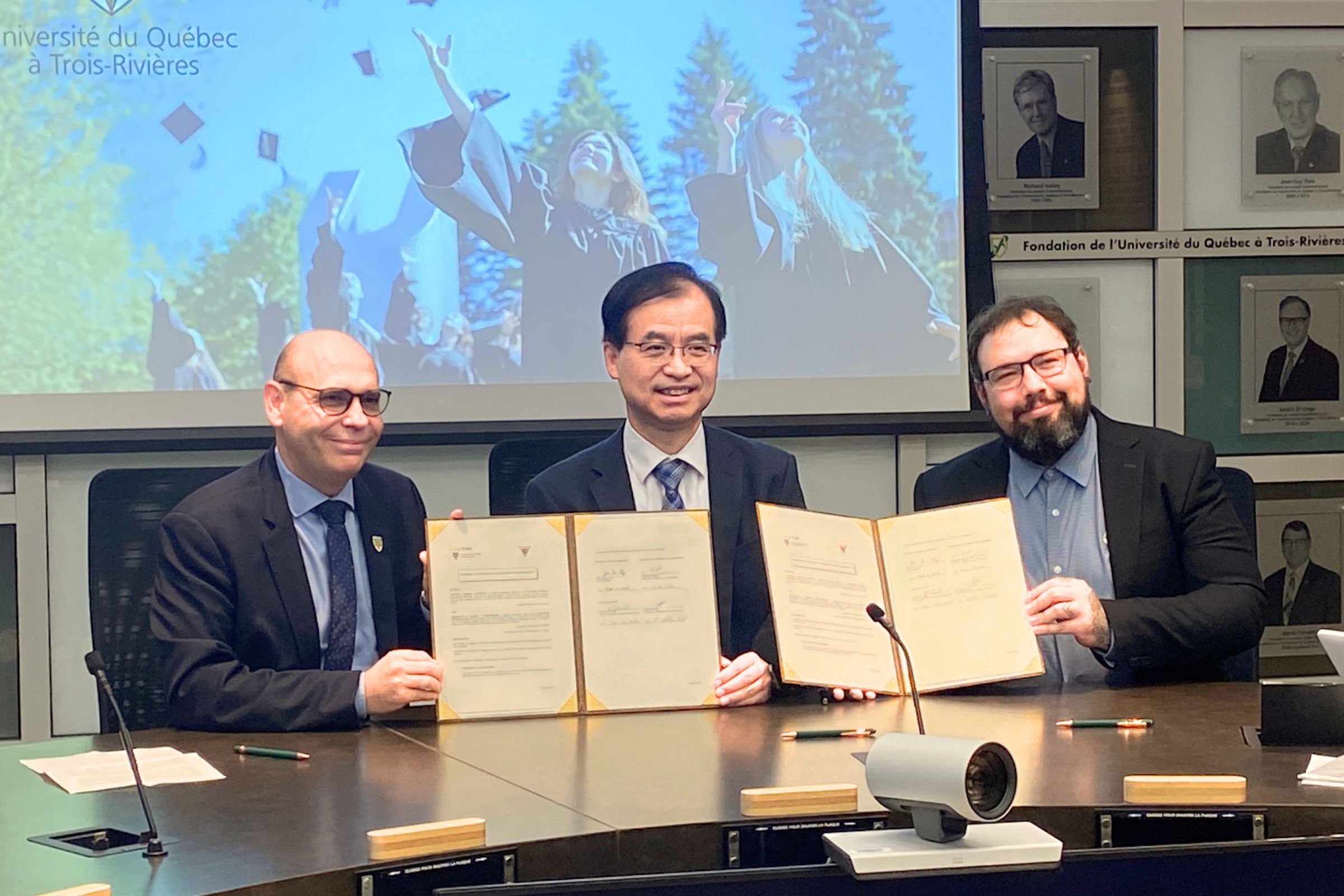
A delegation from National Central University (NCU) visited the Université du Québec à Trois-Rivières (UQTR) in Canada on October 1 to sign a Memorandum of Understanding (MOU). Focusing on hydrogen energy technologies, the partnership will promote joint research, faculty and personnel exchanges, international project applications, and the commercialization of technological innovations. This collaboration marks a significant step forward in strengthening Taiwan-Canada cooperation in clean energy and the transition toward net zero.
The signing ceremony was jointly conducted by Sébastien Charles, Vice-Rector of UQTR; Thomas Auvray, Co-Director of UQTR’s Hydrogen Research Institute; and Tseng Chung-Jen, Director of NCU’s Hydrogen Energy Research Center. The ceremony was attended by key experts and representatives from both Taiwan and Canada. The Taiwanese delegation included representatives from the Ministry of Economic Affairs’ Energy Administration, including Deputy Division Chief Peng Shu-Mei and Specialist Yang Shu-Duan. The Industrial Technology Research Institute (ITRI) was represented by Division Chief Tsai Li-Duan and Specialist Tsai Ying-Wen from the Mechanical and Mechatronics Systems Research Laboratories, as well as Division Chief Fang Meng-De and Deputy Administrator Kuo Yi-Chen from the Green Energy and Environment Research Laboratories. NCU’s Hydrogen Energy Research Center was represented by Deputy Director Professor Hong Wei-Hsuan and Associate Professor Shen Chia-Chieh. The Canadian participants included representatives from the Canadian Trade Office in Taipei, the administrative and research leadership of UQTR’s Hydrogen Research Institute, and the UQTR International Affairs Office. Both parties also expressed their sincere appreciation to the Canadian Trade Office in Taipei for its invaluable support in facilitating this milestone partnership.
According to Tseng Chung-Jen, achieving a net-zero future requires holistic energy solutions grounded in scientific evidence, economic viability, and social responsibility. He emphasized that hydrogen energy serves as a vital link connecting renewable energy, industrial decarbonization, transportation, energy storage, and grid resilience. However, because hydrogen development encompasses a broad range of areas—including hydrogen production and storage, energy conversion, and safety regulations—cross-disciplinary and cross-border collaboration is essential to advancing technological maturity and accelerating real-world deployment.
NCU’s Hydrogen Energy Research Center has extensive expertise in hydrogen production and storage, fuel cells, electrolysis, and energy system integration. This expertise complements the strong research foundation and comprehensive experimental capabilities of UQTR’s Hydrogen Research Institute, which has been conducting hydrogen-related research since its establishment in 1994. Looking ahead, the partnership will establish mobility programs for graduate students, postdoctoral researchers, and faculty members; build joint research alliances; and pursue international research funding opportunities. More importantly, it will help translate laboratory-scale breakthroughs into real-world demonstrations and commercially scalable technologies. This MOU represents more than a formal partnership. It establishes a vital corridor for hydrogen innovation, talent development, and sustainable energy transition, further strengthening the connection between Taiwan and Canada in the pursuit of a net-zero future.


