Academic News

Glutamate (Glu), an important amino acid in plants, is essential for protein synthesis and nitrogen metabolism. Beyond its metabolic functions, whether Glu also serves as a signaling molecule has long been an important question in plant science. A research team led by Professors Ching-Hui Yeh and Ming-Hsiun Hsieh of the Department of Life Sciences at National Central University has recently discovered that exogenous Glu not only serves as a nitrogen source for plants but can also be perceived as a “danger signal.” Glu subsequently influences plant growth, defense, and root hair development through distinct phytohormone and transcriptional regulatory pathways. The findings were recently published in the international journal Plant Physiology.
Glu’s signaling function is well established in animals, where it serves as a major neurotransmitter in humans. Although plants do not have a nervous system, accumulating evidence indicates that Glu can also function as a signaling molecule in plants and influence a wide range of physiological processes, including growth and development. Using the model plant Arabidopsis thaliana, the research team of Professors Yeh and Hsieh investigated the physiological and molecular responses triggered by exposure to exogenous Glu.
The researchers found that exogenous Glu rapidly induced the expression of defense-related genes while suppressing the expression of photosynthesis-related genes. Further experiments demonstrated that Glu-induced defense responses enhanced plant resistance to bacterial pathogens. These findings suggest that plants may perceive extracellular Glu as a “danger signal,” triggering defense responses associated with the phytohormones salicylic acid, jasmonic acid, and ethylene, thereby enhancing plant immunity.
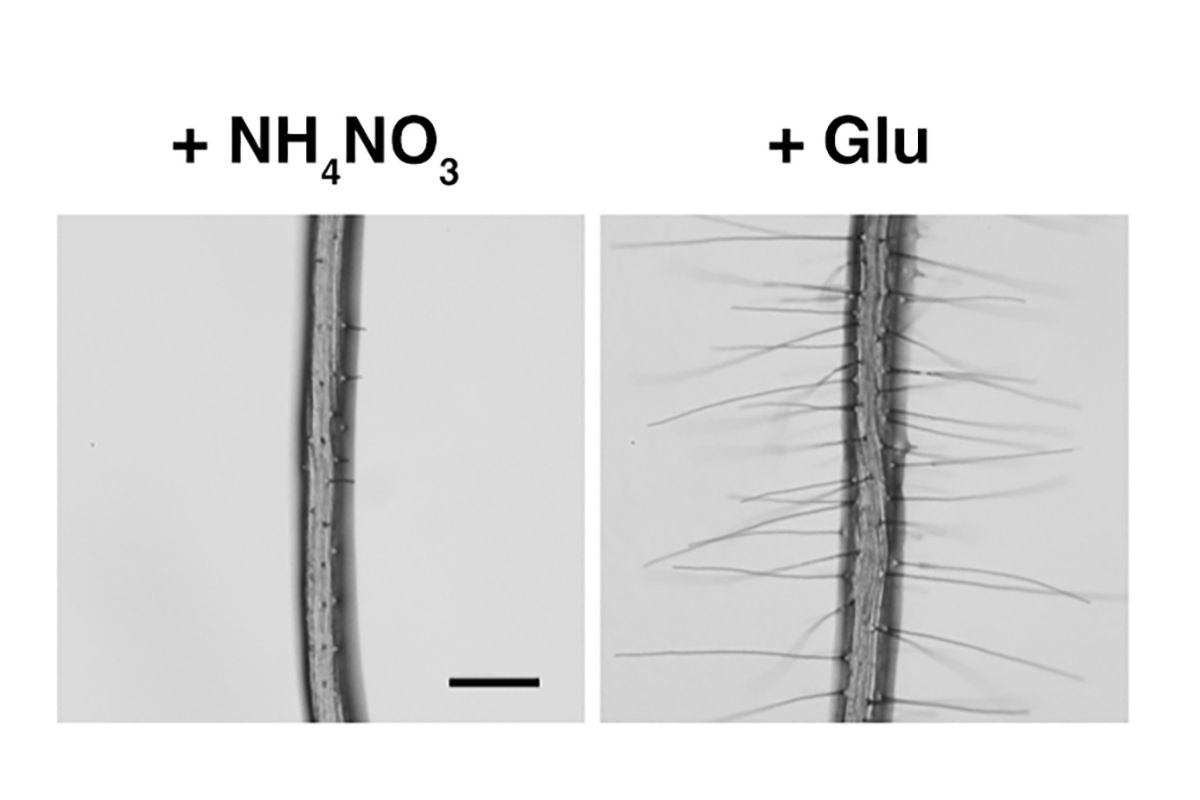
Beyond its effects on plant immunity, Glu also promotes root hair elongation. The study showed that Arabidopsis perceives exogenous Glu at the root tip, which subsequently promotes root hair elongation. This response requires ROOT HAIR DEFECTIVE6 (RHD6), a key transcription factor involved in root hair development, as well as the ethylene signaling pathway. Together, these findings support a working model in which a putative cell-surface Glu receptor perceives extracellular Glu and activates signaling pathways that regulate both defense responses and root hair development.
This study was conducted primarily by Yi-Jie Hung, a master’s student in the collaborative graduate program between National Central University and the Institute of Plant and Microbial Biology, Academia Sinica, under the joint supervision of Professors Ching-Hui Yeh and Ming-Hsiun Hsieh. The findings demonstrate that exogenous Glu may function simultaneously as both a “nutrient” and a “danger signal.” This study not only expands our understanding of Glu's metabolic and signaling functions in plants but also highlights plants' remarkable ability to coordinate growth and defense. In response to constantly changing environmental conditions and challenges, plants can dynamically balance the demands of growth and defense to enhance their survival.