Academic News
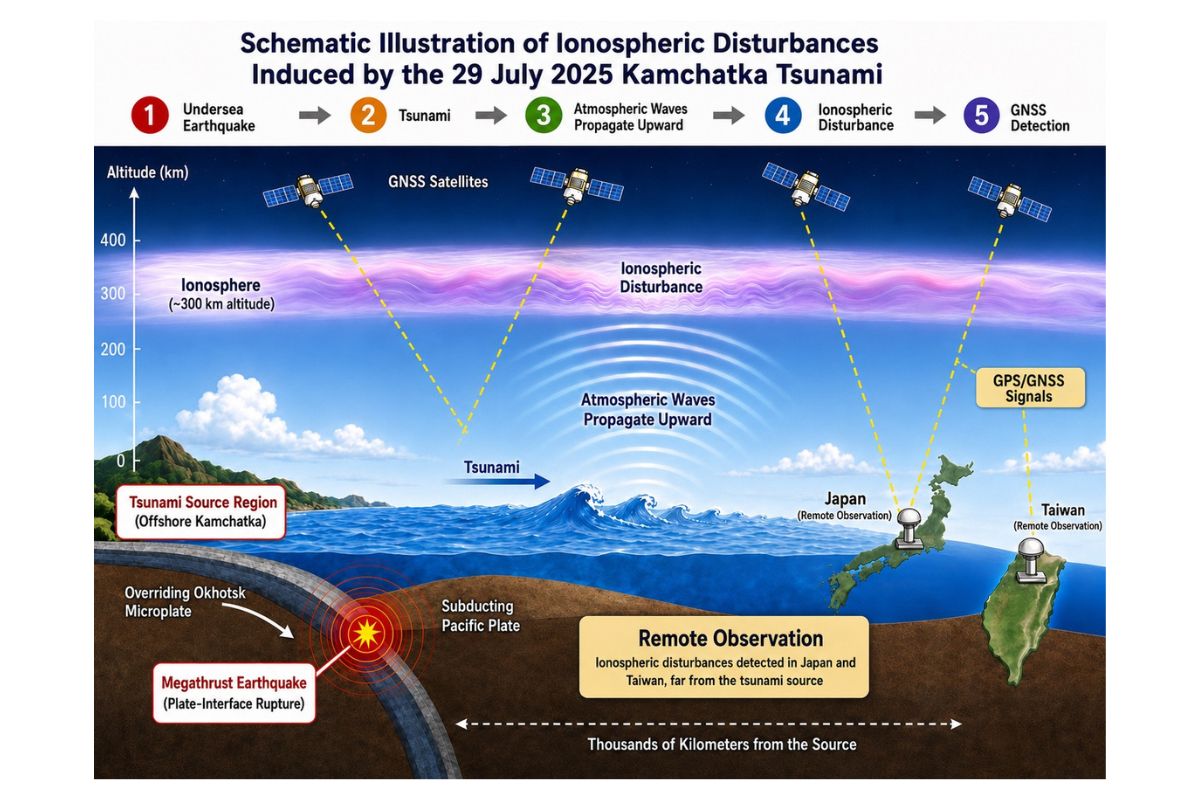
The magnitude 8.8 earthquake that struck off Russia's Kamchatka Peninsula on July 29, 2025, triggered a trans-Pacific tsunami and left detectable disturbances hundreds of kilometers above Earth in the ionosphere. A research team led by National Central University (NCU), including Ph.D. student Tien-Chi Liu, Professor Jann-Yenq Liu, Yushan Scholar Prof. Kenji Satake and Dr. Chun-Yen Huang of Kyoto University, successfully detected ionospheric disturbances generated by the earthquake and tsunami using data from more than 1,400 Global Navigation Satellite System (GNSS) receivers across Japan and Taiwan. Their findings have been published in Geophysical Research Letters.
The study represents a significant breakthrough in far-field observations. Despite the observation network being located more than 2,000 kilometers from the earthquake epicenter, the researchers successfully identified weak ionospheric signals by integrating large-scale GNSS observations with standardized data processing, ray-tracing analysis, and beamforming techniques. These methods enabled the team to reconstruct the tsunami source from subtle disturbances in the upper atmosphere.
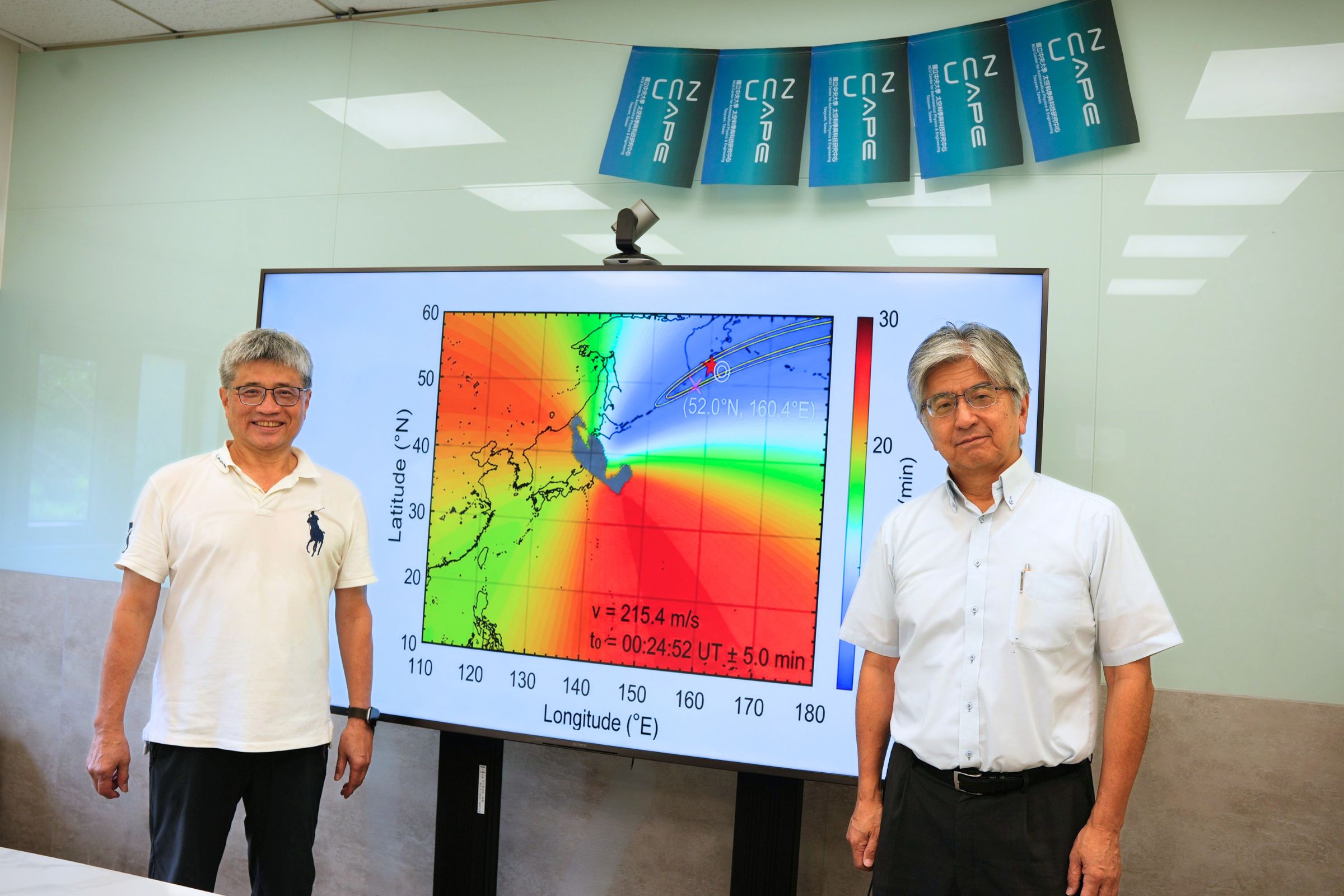
The analysis revealed three distinct types of ionospheric waves. The first, traveling at approximately 3.6 kilometers per second, was generated directly by the seismic waves. The other two propagated at approximately 273 and 215 meters per second—velocities consistent with tsunami propagation in the ocean—confirming that tsunami-driven atmospheric waves can travel upward and produce measurable perturbations in the ionosphere detectable by GNSS observations.
The tsunami source inferred from the first ionospheric disturbance differed by only about 90 kilometers from the principal seafloor slip region independently derived from DART (Deep-ocean Assessment and Reporting of Tsunamis) pressure-gauge data by Prof. Kenji Satake and collaborators. This close agreement demonstrates that ionospheric observations can accurately identify the location of major submarine rupture and tsunami generation.
According to Prof. Jann-Yenq Liu, the ionosphere functions as a vast natural sensing network above Earth. Rapidly determining tsunami source locations and propagation directions through ionospheric observations could strengthen tsunami early-warning capabilities and improve disaster preparedness throughout the Pacific region.